Monday, January 31, 2011

How does this space make you feel? Precedent 1 - Healing/Paimio Sanitorium by Alvar Aalto


I am drawn to the idea that Architects have the power to adjust the mood, and in turn health, of a person who experiences a controlled space. It is already known that certain colors can make people hungry (example : yellow, McDonald's). Smells can bring forth memories from the past (baked cookies, home). This can also work in Hospital environments.
In 1929, Alvar Aalto designed Paimio Sanatorium for the Tuberculosis Outbreak in Finland. Each detail of the building is created with the intention of healing the patients, and creating a sense of community. Since doctors prescribed sunshine as a treatment for the illness, Aalto made sure to situate the patient rooms to face southward. The many common rooms (group settings) were placed near the treatment rooms so that patients had ample time to create connections with each other. Aalto did not use technology as the basis of his design, but as a piece of a dialogue that the human has with his surroundings. Emphasis is made on the connections between the different wings, both by color and spatial changes. He designed each piece of furniture and detailing with great care, including a splashless, quiet sink which was placed on each side of the patient rooms. This building is successful in many ways, which is apparent in the fact that it is still used today.

WHY IS THIS INTERESTING? A buzzword in Healthcare design these days is "healing", but I believe it is overused. Building according to code doesn't create a "healing" environment. The Paimio Sanitorium could be written on a Doctor's prescription because the building itself becomes a part of the patient's treatment. It becomes more than a space where the doctor can do their work, but the building becomes a doctor in itself.

Saturday, January 29, 2011

Destination : Unknown

In taking a few steps back, I am trying to really understand what makes emotive spaces, and why I think some sticks and bricks can actually become emotional catalysts for a social group.

I began by doing a massing study with some different spaces/shapes, and began to picture myself in these spaces. Each space is interesting in itself, but how do you know if it is an interesting space without moving through un-interesting spaces along the way?
In an urban landscape (Dallas, for example), often times, buildings are placed in a block, without much consideration of the surroundings. Once the boundary lines of a site are drawn, the landscape outside of these lines disappears.


What if you had a multi-block site, where there were multiple paths that could be experienced, in between buildings? The goal would be to have different architects design their own buildings, but to always bear in mind how these buildings would be affecting/connecting to the others?
I considered middle eastern bazaars, but these are still separated, even though they are connected under one roof. This would need to be an more of an experience:
You go to the coffee shop building,
grab a coffee, (decide if you want to get a sandwich or a pastry)
follow a pathway into the pastry shop,
grab a puff pastry, (decide if you want to sit or keep walking)
walk to the outdoor seating space and meet your friend, (decide if you want to hit the bank or check out a book)
walk down the stairs into a library,
etc

Almost like the "Choose Your Own Adventure" books that we used to read as kids.

What type of spaces could use this type of experiential organization?
This happens all the time in a Facilities Business Plan at the scale of a building. Does this happen at a urban scale?


These are a couple things I am contemplating. I hope to do an "Exquisite Corpse" study, where I provide a realistic block, create a space, and pass the site to different architect friends and see what they can add with the one rule that each building must connect in some way.

Wednesday, January 26, 2011

Defining Thesis Words


Here's my first pass at the thesis words. It's not what I want, but I am moving.

Thesis as a Music Video

I am having trouble trying to visualize heterotopia without thinking of a cemetary (life & death). I don't think I want to be limited to the idea of cemetaries, but I am hoping I can make correlations between all of my ideas (through film, video, photography, paintings), and eventually, maybe in a few months, revisit the idea of if I can successfully show this through a specific architecture, or if I should keep moving in generalities and hope this idea will work through several types of buildings.
I came across this music video, and it seems to describe heterotopia in a 3 minute box. It is a mental reach, but this song/video works in layers in my head.
There is the light/dark, life/death, materials, feelings. Towards the buildup of the video, there is the idea of illusion vs. reality with the bucket of paint/person standing.

Musically, this song feels like circulation through a space -
it begins with a methodical quick stroll
then slowly anxiety is introduced with the high pitched strings
the walk is slowed down to a gut wrenching pause into a space full of tight spaces and dark corners
and the end climaxes with natural light slowly entering the space, and finding the exit door.
I'm wondering if maybe I should find a space that makes me feel like this and video tape it, and then study the "moments" where my emotions change.


Radiohead - Street Spirit (Fade Out)

Tuesday, January 25, 2011

SOTUA Word Cloud

In an attempt to refuel the brain juices (gross) I found this word cloud for the State of the Union Address. The more the words were said, the bigger the words.
This is a successful way to show the important words that were said, which becomes a great visual summary of a super long speech.


(image via http://www.wordle.net/gallery?username=NPR) which incidentally opened the word cloud for everyone, and got some funny ones (mostly with SALMON) as the focus point.

Saturday, January 15, 2011

Why Do I Hate the Airport So Much?

While sitting at the DFW airport for 5 hours, I contemplated what I could do to improve the
"waiting" experience. I realized the most frustrating part was the continued sitting posture that all the chairs required you to adhere to. I noticed everyone using the seats in all sorts of manners (could be a sketch problem in itself), but never the way the chair was intended. Give the people more choices! We're paying enough for a four hour ride to deserve it!

CURIOUS, EXCITING, and PASSIONATE [architecture]

Architecture that is CURIOUS - Humans vs. Architecture
I have always been interested in understanding how buildings shape people, and also how people shape buildings. Can we create a building that creates calm? Can we create a building that creates confusion, anxiety? See below, the Alzheimer's Center by Frank Gehry. If your grandparent was an Alzheimer's patient, is this a place you would want them to go? For me, Architecture is less designing to make a statement, and more designing to improve society. Is this acceptable?

(photo via besthomesdesign.com)

Architecture that is EXCITING - Construction Administration
The most exciting part of architecture for me is Construction Administration. As the submittals and RFIs come to my desk at work, I know that my decisions on what manufacturer of roof shingles, or what handrail finish is being used is being built hundreds of miles away. As Peter Zumthor stated in Thinking Architecture, "The real core of all Architectural work lies in the act of Construction ."(11) Verbal and Constructional interactions between the Architect and the Consultants helps direct a building to become a collage of everyones' thoughts combined into one. Again, this becomes everyone's vision, not just the Architects. I suppose the AIA would look down on me for feeling this way about Architecture.

Architecture that is PASSIONATE - Zaha Hadid
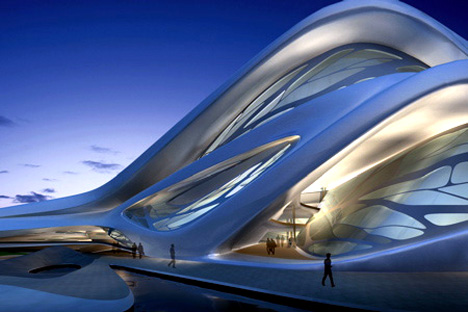
Zaha Hadid is the Architect that I would most like to understand. She creates Architecture that looks like it is sprinting when it is anchored to the ground. Below is the Abu Dhabi Performing Arts Center. This building is not just an amoebas structure with drainage problems. It is a building whose interior forms a direct interplay with the exterior. In addition to the dramatic form itself, the building also answers the need for an intersection of pedestrian paths in the cultural district of where this is located. Hadid does not turned a blind eye to her surroundings, and for this, i feel she is a responsible Architect that evokes passion in her buildings.
(image via yankodesign.com)